

Enhance your career with SC-401 PDF Dumps - True Microsoft Exam Questions
New (2026) Download free SC-401 PDF for Microsoft Practice Tests
NEW QUESTION # 124
You have a Microsoft 365 E5 tenant.
You create a data loss prevention (DLP) policy.
You need to ensure that the policy protects documents in Microsoft Teams chat sessions.
Which location should you enable in the policy?
- A. Teams chat and channel messages
- B. SharePoint sites
- C. OneDrive accounts
- D. Exchange email
Answer: C
Explanation:
Documents shared in Team Chats are stored in OneDrive and shared in Channel Chats are stored in SharePoint Sites.
NEW QUESTION # 125
You need to create a retention policy to delete content after seven years from the following locations:
* Exchange Online email
* SharePoint Online sites
* OneDrive accounts
* Microsoft 365 Groups
* Teams channel messages
* Teams chats
What is the minimum number of retention policies that you should create?
- A. 0
- B. 1
- C. 2
- D. 3
Answer: B
Explanation:
for each of the following you can have a retention policy
1.EXO, SPO, ODfB, M365 groups
2.Teams channel messages, teams chat
3.Teams private channel messages
NEW QUESTION # 126
You have a Microsoft 36S E5 subscription that has a Microsoft Purview exact data match (EDM) classifier named EDM1.
You plan to create the Microsoft Purview policies shown in the following table.
Which policies can use EDM1?
- A. DLP1 only
- B. DLP1 and Insider1 only
- C. Insider1 and Retention1 only
- D. DLP1. Insider1, and Retention1
- E. Retention 1 only
Answer: A
Explanation:
Comprehensive Detailed Explanation with References
Exact Data Match (EDM) classifiers are designed to identify highly sensitive structured data (like customer IDs, account numbers) with higher accuracy.
EDM classifiers can only be used within Data Loss Prevention (DLP) policies in Microsoft Purview.
They cannot be used in Insider Risk Management or Retention policies.
Reference: EDM classifiers in Microsoft Purview
"EDM sensitive information types can only be used in data loss prevention policies."
NEW QUESTION # 127
You have a Microsoft 365 E5 subscription that contains a user named User1.
You need to ensure that all email messages that contain attachments are encrypted automatically by using Microsoft Purview Message Encryption.
What should you create?
- A. a sensitivity label
- B. a data loss prevention (DLP) policy
- C. an information barrier segment
- D. a mail flow rule
Answer: D
NEW QUESTION # 128
You have a Microsoft 365 E5 subscription that uses Microsoft Purview.
You need to deploy a compliance solution that will detect the accidental oversharing of information outside of an organization.
The solution must minimize administrative effort.
What should you use? To answer, select the appropriate options in the answer area.
NOTE: Each correct selection is worth one point.
Answer:
Explanation:
Explanation:
NEW QUESTION # 129
You need to meet the technical requirements for the Site1 documents.
Which three actions should you perform in sequence? To answer, move the appropriate actions from the list of actions to the answer area and arrange them in the correct order.
Answer:
Explanation:
Explanation:
A screenshot of a questionnaire AI-generated content may be incorrect.
The goal is to automatically label documents in Site1 that contain credit card numbers. To achieve this, we need a sensitivity label with an auto-labeling policy based on a sensitive info type that detects credit card numbers.
Step 1: Create a Sensitive Info Type
# A sensitive info type is needed to detect credit card numbers in documents.
# Microsoft Purview includes built-in sensitive info types for credit card numbers, but we can also create a custom one if necessary.
Step 2: Create a Sensitivity Label
# A sensitivity label is required to classify and protect documents containing sensitive information.
# This label can apply encryption, watermarking, or access controls to credit card data.
Step 3: Create an Auto-Labeling Policy
# An auto-labeling policy ensures that the sensitivity label is applied automatically when credit card numbers are detected in Site1.
# This policy is configured to scan files and automatically apply the correct sensitivity label.
NEW QUESTION # 130
You have a Microsoft 365 E5 subscription that uses Microsoft Purview.
You are creating an exact data match (EDM) classifier named EDM1.
For EDM1, you upload a schema file that contains the fields shown in the following table.
What is the maximum number of primary elements that EDM1 can have?
- A. 0
- B. 1
- C. 2
- D. 3
Answer: B
Explanation:
In Microsoft Purview Exact Data Match (EDM) classifiers, a primary element is a unique, identifying field used for data matching. EDM allows up to two primary elements per schema.
From the provided table, the Match mode indicates how data is analyzed:
*PP (EU Passport Number) → Likely a primary element because it's unique.
*Name (All Full Names) → Typically not a primary element as names are common.
*DateOfBirth (Single-token) → Usually a secondary element, not unique.
*AccountNumber (Multi-token) → Can be a primary element, as it's a unique identifier.
*Since EDM supports a maximum of two primary elements, the correct answer is 2.
NEW QUESTION # 131
SIMULATION
Username and password
Use the following login credentials as needed:
To enter your username, place your cursor in the Sign in box and select the username below.
To enter your password, place your cursor in the Enter password box and select the password below.
Microsoft 365 Username:
[email protected]
Microsoft 365 Password: XXXXXXXXX
If the Microsoft Edge browser or Microsoft 365 portal does not load successfully, select the Microsoft Edge browser icon from the task bar, type the URL "https://admin microsoft.com", and press Enter.
The following information is for technical support purposes only:
Lab Instance: XXXXXXXX.
Task 3
You plan to automatically apply a watermark to the documents of a project named Falcon.
You need to create a label that will add a watermark of "Project Falcon" in red, size-12 font diagonally across the documents.
Answer:
Explanation:
Create and configure sensitivity labels
Step 1: From the Microsoft Purview compliance portal, select Solutions > Information protection > Labels Step 2: On the Labels page, select + Create a label to start the new sensitivity label configuration:
Step 3: On the Define the scope for this label page, the options selected determine the label's scope for the settings that you can configure and where they'll be visible when they're published.
In our case select: Items, Files, and select Word documents.
Note: If Items is selected, you can configure settings that apply to apps that support sensitivity labels, such as Office Word and Outlook. Optionally, you can extend these labels to include meetings from Teams and Outlook, and to protecting Teams meetings themselves by enforcing settings for Teams meetings and related chat.
Step 4: Follow the configuration prompts for the label settings. Use the help in the UI for individual settings.
Step 5: In the UI add a watermark of "Project Falcon" in red, size-12 font diagonally across the document.
Note: What sensitivity labels can do
After a sensitivity label is applied to an email, meeting invite, or document, any configured protection settings for that label are enforced on the content. You can configure a sensitivity label to:
* Mark the content when you use Office apps, by adding watermarks, headers, or footers to email, meeting invites, or documents that have the label applied. Watermarks can be applied to documents but not email or meeting invites. Example header and watermark:
Step 6: Finish the Wizard
Reference:
https://learn.microsoft.com/en-us/purview/create-sensitivity-labels
https://answers.microsoft.com/en-us/msteams/forum/all/how-to-automatically-apply-sensitivity- labels-to/2482d1b2-1fe6-4a80-af4a-2b93b9c670de
NEW QUESTION # 132
You have a Microsoft 36S ES subscription.
You plan to use the Microsoft Purview portal to map human resources (HR) data for use with insider risk management policies.
You need to add a data connector to import the HR data.
What should you do first and in which format should you import the data? To answer, select the appropriate options in the answer area.
NOTE: Each correct selection is worth one point.
Answer:
Explanation: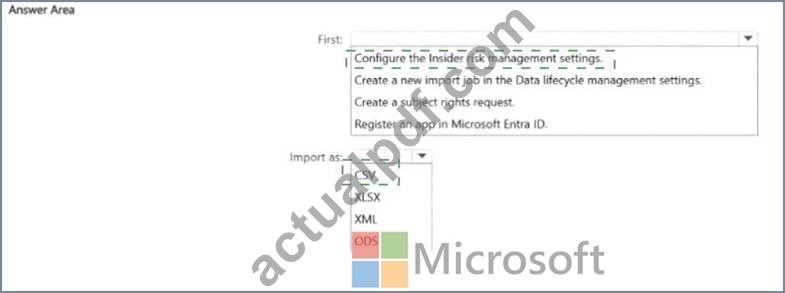
Explanation:
NEW QUESTION # 133
You have a Microsoft 36S ES subscription that contains the devices shown in the following table.
You plan to implement inside' risk management and capture forensic evidence Which devices support the collection of forensic evidence, and what should you do lo prepare each supported device? To answer, select the appropriate options in the answer area.
NOTE: Each correct selection is worth one point.
Answer:
Explanation:
Explanation:
The question is about Insider Risk Management forensic evidence collection in Microsoft 365 E5 (Microsoft Purview).
# Step 1 - Which devices are supported?
According to Microsoft documentation, forensic evidence collection for insider risk investigations is supported only on:
Windows 10
Windows 11
It is not supported on:
macOS
Android
iOS
# Reference: Forensic evidence collection in Microsoft Purview Insider Risk Management
# So, only Device1 (Windows 11) and Device2 (Windows 10) qualify.
# Step 2 - What preparation is needed?
For forensic evidence to be collected, supported devices must:
Be onboarded to Microsoft Purview (via Microsoft Defender for Endpoint integration).
Have the Microsoft Purview client installed.
This enables capture of user actions such as file copies, USB transfers, printing, etc., to provide forensic evidence for insider risk alerts.
# Correct option: Onboard the devices to Microsoft Purview and install the Microsoft Purview client
NEW QUESTION # 134
Hotspot Question
You have a Microsoft 365 E5 subscription that contains a Microsoft SharePoint Online site named Site1. Site1 contains three files named File1, File2, and File3.
You create the data loss prevention (DLP) policies shown in the following table.
The DLP rule matches for each file are shown in the following table.
How many DLP policy matches events will be added to Activity explorer, and how many policy matches will be added to the DLP incidents report? To answer, select the appropriate options in the answer area.
NOTE: Each correct selection is worth one point.
Answer:
Explanation:
Explanation:
A "DLP policy matches event" is when a user's activity, such as sharing a file or sending an email, triggers a predefined set of rules in a Data Loss Prevention (DLP) policy. When a match occurs, the DLP system can then take a configured action, such as alerting administrators, notifying the user, or restricting access to the data. This event signifies a potential policy violation, such as sensitive information being sent externally or moved to an unauthorized location.
Box 1: 6
The Activity explorer displays DLP policy matches as detailed events sourced from audit logs, providing a historical view of user activities and their impact on sensitive information. It allows users to filter events by various criteria like date, user, activity type, and location to monitor the effectiveness of DLP policies. Events in the Activity explorer can represent partial matches (where only some conditions were met) and full matches, with details on the conditions that triggered the match available through further filtering or by reviewing alert details in the DLP alerts interface.
* File1
Rule11 and Rule12 are both in DLP1.
2 events.
Note:
When an item matches multiple DLP rules, DLP goes uses through a complex algorithm to decide which actions to apply. Endpoint DLP applies the aggregate or sum of most restrictive actions.
DLP uses these factors when making the calculation.
* File2
Rule21 and Rule22 are both in DLP2.
2 events.
* File3
Rule11 is DLP1, and Rule22 is in DLP2.
2 events.
Box 2: 3
The Incidents report displays DLP policy matches by aggregating them to an item-level view, meaning a single email that matches multiple rules will only show up once in this report. This contrasts with the Policy Matches report, which counts each rule match separately. The Incidents report is better for identifying specific problematic content, while the Policy Matches report is better for fine-tuning individual rules.
There are 3 files items, so there will be 3 matches.
Reference:
https://learn.microsoft.com/en-us/purview/dlp-policy-reference
https://learn.microsoft.com/en-us/purview/dlp-learn-about-dlp
https://learn.microsoft.com/en-us/purview/data-classification-activity-explorer
NEW QUESTION # 135
You have a Microsoft 365 E5 subscription.
You need to ensure that users are prevented from uploading sensitive data to ChatGPT and Google Gemini.
The solution must meet the following requirements:
* Prevent credit card numbers from being pasted into ChatGPT and Gemini.
* Prevent documents that contain classified data from being uploaded to ChatGPT and Gemini.
Which Microsoft Purview solution should you use for each requirement? To answer, select the appropriate options in the answer area.
NOTE: Each correct selection is worth one point.
Answer:
Explanation:
Explanation:
Step 1 - Requirement analysis
You need to prevent users from:
Pasting credit card numbers into ChatGPT/Google Gemini.
Uploading classified documents into ChatGPT/Google Gemini.
Both scenarios involve AI websites. Microsoft Purview provides Data Security Posture Management for AI and Endpoint DLP integrations that work through Data Loss Prevention (DLP) and Insider Risk Management policies.
Step 2 - Credit card numbers
Credit card numbers are structured sensitive information types (SITs).
DLP policies are the correct Microsoft Purview solution for detecting and blocking sensitive info (e.g., credit card, SSN, health ID) from being copied, pasted, or uploaded into restricted destinations like AI apps.
Therefore, Data Loss Prevention is the right choice.
# Reference: Learn about Endpoint DLP and AI sites
Step 3 - Documents
Documents containing classified or labeled data (via sensitivity labels) fall under insider risk activity detection when exfiltrated.
Insider Risk Management policies can monitor and block uploads of classified/labeled files to AI services such as ChatGPT or Gemini.
Therefore, Insider Risk Management is the right choice for preventing document uploads.
# Reference: Insider Risk Management - risky AI activity detection
NEW QUESTION # 136
You have a Microsoft 365 E5 subscription.
You need to identify documents that contain patent application numbers containing the letters PA followed by eight digits, for example, PA 12345678. The solution must minimize administrative effort.
What should you do? To answer, select the appropriate options in the answer area.
NOTE: Each correct selection is worth one point.
Answer:
Explanation: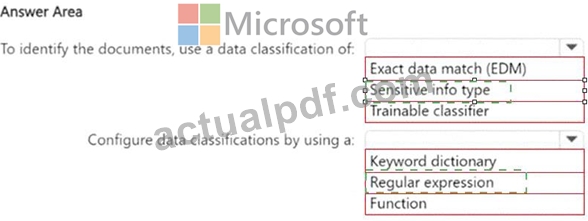
Explanation:
Box 1: Since you are looking for a specific pattern (PA followed by eight digits, e.g., PA 12345678), the best classification method is Sensitive Info Type. Sensitive Info Types allow pattern-based matching to identify structured data. Exact Data Match (EDM) is not needed because you're not comparing against a fixed dataset.
Trainable classifier is not appropriate because this is a structured pattern, not an unstructured document classification.
Box 2: Since PA 12345678 follows a structured pattern, the most effective method is Regular Expression (Regex). A Regular Expression (Regex) can be written to match "PA" followed by exactly eight digits (e.g., PA\s\d{8}). Keyword dictionary is not ideal because it works for predefined words, not number patterns.
Function is unnecessary because there is no need for checksum validation or predefined validation rules.
NEW QUESTION # 137
Drag and Drop Question
You have a Microsoft 365 5 subscription that uses Microsoft Purview insider risk management and contains three users named User1, User2, and User3.
All insider risk management policies have adaptive protection enabled and the default conditions for insider risk levels configured.
The users perform the following activities, which trigger insider risk policy alerts:
- User1 performs at least one data exfiltration activity that results in a high severity risk score.
- User2 performs at least three risky user activities within seven days, that each results in a high severity risk score.
- User3 performs at least two data exfiltration activities within seven days, that each results in a high severity risk score.
Which insider risk level is assigned to each user? To answer, drag the appropriate levels to the correct users. Each level may be used once, more than once, or not at all. You may need to drag the split bar between panes or scroll to view content.
NOTE: Each correct selection is worth one point.
Answer:
Explanation:
Explanation:
Box 1: Minor risk level
User1 performs at least one data exfiltration activity that results in a high severity risk score.
Minor:
This is the lowest risk level, assigned to users with low-severity alerts or those with at least one high-severity exfiltration activity.
Box 2: Elevated risk level
User2 performs at least three risky user activities within seven days, that each results in a high severity risk score.
Elevated:
This is the highest risk level, assigned to users with high-severity alerts, multiple high-severity insights, or confirmed high-severity alerts.
Box 3: Moderate risk level
User3 performs at least two data exfiltration activities within seven days, that each results in a high severity risk score.
Moderate:
This level indicates a medium risk, assigned to users with medium-severity alerts or those with at least two high-severity exfiltration activities.
Reference:
https://learn.microsoft.com/en-us/purview/insider-risk-management-adaptive-protection
NEW QUESTION # 138
You have a sensitive information type based on a trainable classifier.
You are unsatisfied with the result of the trainable classifier.
You need to retrain the classifier.
What should you use in the Microsoft Purview portal?
- A. Labels from Information governance
- B. Content search
- C. Labels from Information protection
- D. Content explorer from Data classification
Answer: D
Explanation:
Trainable classifiers in Microsoft Purview learn from sample documents. When the initial results are unsatisfactory, retraining is done by reviewing and reclassifying items through Content explorer under the Data classification section of the Purview compliance portal. This allows you to give feedback by marking documents as "relevant" or "not relevant" to improve classifier accuracy.
The other options do not support retraining:
Labels from Information protection # Used to configure and manage sensitivity labels, not train classifiers.
Labels from Information governance # Used for retention labels, not classifiers.
Content search # Used for eDiscovery and searching content, not classifier training.
Reference: Trainable classifiers in Microsoft Purview
NEW QUESTION # 139
You have a Microsoft 36S ES subscription.
From the Microsoft Purview Data Security Posture Management for Al portal, you review the recommendations for Al data security You plan to create a one-click policy to block elevated risk users from pasting or uploading sensitive data to Al websites How will the policy be configured? To answer, select the appropriate options in the answer area NOTE: Each correct selection is worth one point.
Answer:
Explanation:
Explanation:
NEW QUESTION # 140
You have a Microsoft 365 E5 subscription that contains three DOCX files named File1, File2, and File3.
You create the sensitivity labels shown in the following table.
You apply the labels to the files as shown in the following table.
You ask Microsoft 365 Copilot to summarize the files, and you receive the results shown in the following table.
For each of the following statements, select Yes if the statement is true. Otherwise, select No.
NOTE: Each correct selection is worth one point.
Answer:
Explanation:
Explanation:
NEW QUESTION # 141
You have a Microsoft 365 E5 subscription that contains the users shown in the following table.
You have the data loss prevention (DLP) policies shown in the following table.
From Insider risk management, you configure a priority user group named PriGroup1 that contains User3 as a member. You have the insider risk policies shown in the following table.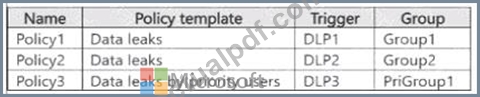
For each of the following statements, select Yes if the statement is true. Otherwise, select No.
NOTE: Each correct selection is worth one point.
Answer:
Explanation:
Explanation:
NEW QUESTION # 142
SIMULATION
Username and password
Use the following login credentials as needed:
To enter your username, place your cursor in the Sign in box and select the username below.
To enter your password, place your cursor in the Enter password box and select the password below.
Microsoft 365 Username:
[email protected]
Microsoft 365 Password: XXXXXXXXX
If the Microsoft Edge browser or Microsoft 365 portal does not load successfully, select the Microsoft Edge browser icon from the task bar, type the URL "https://admin.microsoft.com", and press Enter.
The following information is for technical support purposes only:
Lab Instance: XXXXXXXXX
Task 1
You plan to implement Endpoint data loss prevention (Endpoint DLP). You plan to create a policy that will restrict OneDrive.exe from accessing files that have the Highly Confidential sensitivity label.
You need to configure the Endpoint DLP settings so that onedrive.exe actions can be restricted by a DLP policy.
You do NOT need to create a DLP policy at this time.
Answer:
Explanation:
To restrict onedrive.exe actions in Microsoft Purview, you first configure it as a restricted app group in Endpoint DLP settings and then add that group to a DLP policy in the Microsoft Purview portal. In the Endpoint DLP settings, navigate to Data loss prevention > Settings > Data loss prevention > Endpoint settings > Restricted apps and app groups. Create a new group called
"Cloud Sync apps," select the Auto-quarantine option, and add onedrive.exe as the executable name for Windows.
Configure the restricted app group
Step 1: Sign in to the Microsoft Purview portal.
Step 2: Go to Data loss prevention > Settings (gear icon) > Data loss prevention > Endpoint settings.
Step 3: Expand Restricted apps and app groups.
Step 4: Under "Restricted app groups," select Add restricted app group.
Step 5: Enter a group name, such as Cloud Sync apps.
Step 6: Check the box for Auto-quarantine.
Step 7: In the "App name" field, add the executable name:
For Windows, enter onedrive.exe and click the + button.
Reference:
https://learn.microsoft.com/en-us/purview/endpoint-dlp-using
NEW QUESTION # 143
You have a Microsoft 365 E5 tenant that has a retention label named Label1.
You need to create an auto-labeling policy that will apply Label1.
To which location can Label1 be applied?
- A. Teams chats
- B. Teams channel messages
- C. OneDrive accounts
- D. on-premises repositories
Answer: C
Explanation:
Correct:
* OneDrive accounts
Incorrect:
* Microsoft Defender for Cloud Apps
* Microsoft Entra security groups
* on-premises repositories
* Teams channel messages
* Teams chats
Note:
A Microsoft 365 auto-labeling policy can be applied to Exchange mailboxes, SharePoint sites, and OneDrive accounts. It can also be applied to content within Teams and other Microsoft 365 Groups, as well as Azure services like Azure SQL and Azure Cosmos DB.
Exchange Online: Applies to emails in transit.
SharePoint: Applies to documents stored at rest in SharePoint sites.
OneDrive: Applies to documents stored at rest in OneDrive accounts.
Teams: Applies to documents stored in the SharePoint sites associated with a Team.
Azure and other data sources: Can be extended to apply to data stored in services like Azure SQL, Azure Cosmos DB, and more.
Reference:
https://learn.microsoft.com/en-us/purview/apply-sensitivity-label-automatically
NEW QUESTION # 144
You need to meet the retention requirement for the users' Microsoft 365 data.
What is the minimum number of retention policies required to achieve the goal?
- A. 0
- B. 1
- C. 2
- D. 3
- E. 4
Answer: B
Explanation:
The requirement states that all Microsoft 365 data for users must be retained for at least one year. In Microsoft
365, retention policies must be configured for each type of data storage.
Step 1: Identifying Where Data is Stored
From the case study, users store data in the following locations:
# SharePoint Online sites
# OneDrive accounts
# Exchange email
# Exchange public folders
# Teams chats
# Teams channel messages
Since these locations fall under two broad categories:
# Microsoft Exchange data (Emails, Public folders)
# SharePoint, OneDrive, and Teams data
Step 2: Required Retention Policies
1#. A single retention policy can cover:
# SharePoint Online
# OneDrive
# Microsoft Teams
2. A second retention policy is required for:
# Exchange (Emails & Public Folders)
Thus, the minimum number of retention policies required to meet the requirement is 2.
Microsoft 365 retention policies can be applied broadly across multiple services with just two policies:
# One for Exchange & Public Folders
# One for SharePoint, OneDrive, and Teams
There's no need for separate policies for each individual workload unless different retention durations are required, which is not stated in the requirement.
Topic 1, Contoso, Ltd Case Study 1
Instructions
This is a case study. Case studies are not timed separately from other exam sections. You can use as much exam time as you would like to complete each case study. However, there might be additional case studies or other exam sections. Manage your time to ensure that you can complete all the exam sections in the time provided. Pay attention to the Exam Progress at the top of the screen so you have sufficient time to complete any exam sections that follow this case study.
To answer the case study questions, you will need to reference information that is provided in the case. Case studies and associated questions might contain exhibits or other resources that provide more information about the scenario described in the case. Information provided in an individual question does not apply to the other questions in the case study.
A Review Screen will appear at the end of this case study. From the Review Screen, you can review and change your answers before you move to the next exam section. After you leave this case study, you will NOT be able to return to it.
To start the case study
To display the first question in this case study, select the "Next" button. To the left of the question, a menu provides links to information such as business requirements, the existing environment, and problem statements. Please read through all this information before answering any questions. When you are ready to answer a question, select the "Question" button to return to the question.
Overview
Contoso, Ltd. is a consulting company that has a main office in Montreal and three branch offices in Seattle, Boston, and Johannesburg.
Existing Environment
Microsoft 365 Environment
Contoso has a Microsoft 365 E5 tenant. The tenant contains the administrative user accounts shown in the following table.
Users store data in the following locations:
# SharePoint sites
# OneDrive accounts
# Exchange email
# Exchange public folders
# Teams chats
# Teams channel messages
When users in the research department create documents, they must add a 10-digit project code to each document. Project codes that start with the digits 999 are confidential.
SharePoint Online Environment
Contoso has four Microsoft SharePoint Online sites named Site1, Site2, Site3, and Site4.
Site2 contains the files shown in the following table.
Two users named User1 and User2 are assigned roles for Site2 as shown in the following table.
Site3 stores documents related to the company's projects. The documents are organized in a folder hierarchy based on the project.
Site4 has the following two retention policies applied:
# Name: Site4RetentionPolicy1
# Locations to apply the policy: Site4
# Delete items older than: 2 years
# Delete content based on: When items were created
# Name: Site4RetentionPolicy2
# Locations to apply the policy: Site4
# Retain items for a specific period: 4 years
# Start the retention period based on: When items were created
# At the end of the retention period: Do nothing
Problem Statements
Management at Contoso is concerned about data leaks. On several occasions, confidential research department documents were leaked.
Requirements
Planned Changes
Contoso plans to create the following data loss prevention (DLP) policy:
# Name: DLPpolicy1
# Locations to apply the policy: Site2
# Conditions:
# Content contains any of these sensitive info types: SWIFT Code
# Instance count: 2 to any
# Actions: Restrict access to the content
Technical Requirements
Contoso must meet the following technical requirements:
# All administrative users must be able to review DLP reports.
# Whenever possible, the principle of least privilege must be used.
# For all users, all Microsoft 365 data must be retained for at least one year.
# Confidential documents must be detected and protected by using Microsoft 365.
# Site1 documents that include credit card numbers must be labeled automatically.
# All administrative users must be able to create Microsoft 365 sensitivity labels.
# After a project is complete, the documents in Site3 that relate to the project must be retained for 10 years.
NEW QUESTION # 145
You plan to create a new data loss prevention (DLP) policy named DLP1.
DLP1 will be applied to the Exchange email location.
You need to exclude two users named User1 and User2 from DLP1.
What should you do first?
- A. Create an advanced DLP rule.
- B. Create a mail flow rule in Microsoft Exchange.
- C. Create a distribution list that contains User1 and User2.
- D. Create an organization sharing policy in Microsoft Exchange.
Answer: C
Explanation:
Microsoft Purview Data Loss Prevention (DLP) policies have many components to configure. To create an effective policy, you need to understand what the purpose of each component is and how its configuration alters the behavior of the policy. This article provides a detailed anatomy of a DLP policy.
Reference:
https://learn.microsoft.com/en-us/purview/dlp-policy-reference
NEW QUESTION # 146
You have a Microsoft 365 subscription that contains the users shown in the following table.
You review the audit retention period of each user.
Which users' audit logs are retained for nine months?
- A. User3 only
- B. User1, User2, and User3
- C. User2 and User3
- D. User1 and User3
Answer: A
NEW QUESTION # 147
DRAG DROP
You have a Microsoft 365 E5 subscription that has data loss prevention (DLP) implemented.
You need to create a custom sensitive info type. The solution must meet the following requirements:
# Match product serial numbers that contain a 10-character alphanumeric string.
# Ensure that the abbreviation of SN appears within six characters of each product serial number.
# Exclude a test serial number of 1111111111 from a match.
Which pattern settings should you configure for each requirement? To answer, drag the appropriate settings to the correct requirements. Each setting may be used once, more than once, or not at all. You may need to drag the split bar between panes or scroll to view content.
NOTE: Each correct selection is worth one point.
Answer:
Explanation:
Explanation:
NEW QUESTION # 148
......
100% Free SC-401 Files For passing the exam Quickly: https://testinsides.actualpdf.com/SC-401-real-questions.html
