

CyberArk PAM-DEF Cert Guide PDF 100% Cover Real Exam Questions
Pass PAM-DEF Exam - Real Questions and Answers
NEW QUESTION # 111
A recently-hired colleague onboarded five new Local Accounts that are used for five standalone Windows Servers. After attempting to connect to the servers from PVWA, the colleague noticed that the "Connect" button was greyed out for all five new accounts.
What can you do to help your colleague resolve this issue? (Choose two.)
- A. Notify the Windows Team that created the new accounts that the CyberArk PAM solution is not designed to manage local accounts on Windows Servers.
- B. Verify that the address field is blank and that the correct PSM connection component appears within account platform settings.
- C. Verify that the "Disable automatic management for this account" setting for each account is not enabled.
- D. Verify that the correct PSM connection component appears within account platform settings.
- E. Verify that the address field is populated with an IP or FQDN of each server.
Answer: C,D,E
Explanation:
Explanation
* Verify Server Address: Ensure that the address field is populated with the correct IP or FQDN for each server (Option A).
* Check PSM Settings: Confirm that the correct PSM connection component is specified within the account platform settings (Option B).
* Automatic Management: Check if the "Disable automatic management for this account" setting is not enabled (Option E).
These steps should help in troubleshooting the connection issue in the CyberArk Privileged Access Management (PAM) solution.
NEW QUESTION # 112
Which Cyber Are components or products can be used to discover Windows Services or Scheduled Tasks that use privileged accounts? Select all that apply.
- A. Discovery and Audit (DMA)
- B. Auto Detection (AD)
- C. On Demand Privileges Manager (OPM)
- D. Export Vault Data (EVD)
- E. Accounts Discovery
Answer: A,B,E
Explanation:
Explanation
Discovery and Audit (DMA), Auto Detection (AD), and Accounts Discovery are CyberArk components or products that can be used to discover Windows Services or Scheduled Tasks that use privileged accounts.
* Discovery and Audit (DMA) is a tool that scans Windows servers and workstations to identify privileged accounts that are used by Windows Services or Scheduled Tasks. DMA can also generate reports on the usage and risks of these accounts.
* Auto Detection (AD) is a feature of the CyberArk Privileged Account Security Solution that automatically detects and onboards privileged accounts that are used by Windows Services or Scheduled Tasks. AD can also monitor and rotate the passwords of these accounts.
* Accounts Discovery is a feature of the CyberArk Privileged Account Security Solution that scans the network to discover privileged accounts on various platforms, including Windows. Accounts Discovery can also identify accounts that are used by Windows Services or Scheduled Tasks.
References:
* : Discovery and Audit (DMA) User Guide
* : Auto Detection Implementation Guide
* : Accounts Discovery Implementation Guide
NEW QUESTION # 113
Within the Vault each password is encrypted by:
- A. its own unique key
- B. the server key
- C. the recovery private key
- D. the recovery public key
Answer: A
Explanation:
Explanation
According to the web search results, within the Vault each password is encrypted by its own unique key. This key is generated by the Vault when the password is added to the Vault and is stored in the Vault's database.
The password key is encrypted by the safe key, which is the key of the safe that contains the password. The safe key is encrypted by the server key, which is the key that opens the Vault. The server key is encrypted by the public recovery key, which is part of the asymmetric recovery key that enables the Master User to log on to the Vault in case of a disaster. This layered encryption scheme ensures that each password is protected by multiple keys and that no single key can compromise the security of the Vault
NEW QUESTION # 114
Which keys are required to be present in order to start the PrivateArk Server service?
- A. Safe key
- B. Server key
- C. Recovery private key
- D. Recovery public key
Answer: B,D
NEW QUESTION # 115
Match the connection component to the corresponding OS/Function.
Answer:
Explanation:

NEW QUESTION # 116
What is the purpose of a linked account?
- A. To ensure that a particular collection of accounts all have the same password.
- B. To allow more than one account to work together as part of a password management process.
- C. To connect the CPNI to a target system.
- D. To ensure a particular set of accounts all change at the same time.
Answer: B
NEW QUESTION # 117
Which command configures email alerts within PTA if settings need to be changed post install?
- A. /opt/PTA/utility/emailConfig.sh
- B. /opt/tomcat/utility/emailConfiguration.sh
- C. /opt/PTA/emailConfiguration.sh
- D. /opt/tomcat/utility/emailSetup.sh
Answer: B
Explanation:
Explanation
The command to configure email alerts within PTA (Privileged Threat Analytics) after the initial installation is /opt/tomcat/utility/emailConfiguration.sh. This command is used to start the PTA utility that allows you to set up email notifications for various alerts. During the configuration process, you will be prompted to enter details such as the SMTP/S protocol, email server IP address, SMTP port, sender's email address, and recipient's email address. If the mail server requires authentication, you will also need to provide the username and password for the user that will send email notifications1.
References:
* CyberArk's official documentation provides a detailed procedure on how to configure PTA to send alerts to emails, including the use of the /opt/tomcat/utility/emailConfiguration.sh command
NEW QUESTION # 118
Which service should NOT be running on the DR Vault when the primary Production Vault is up?
- A. CyberArk Vault Disaster Recovery (DR) service
- B. CyberArk Logical Container
- C. PrivateArk Database
- D. PrivateArk Server
Answer: D
NEW QUESTION # 119
You are configuring CyberArk to use HTML5 gateways exclusively for PSM connections.
In the PVWA, where do you set DefaultConnectionMethod to HTML5?
- A. Options > Privileged Session Management
- B. Options > Privileged Session Management Defaults
- C. Options > Privileged Session Management UI
- D. Options > Privileged Session Management Interface
Answer: C
Explanation:
Explanation
To configure CyberArk to use HTML5 gateways exclusively for PSM connections, you need to set the DefaultConnectionMethod to HTML5 in the PVWA. This is done by logging in to the PVWA with an administrative user, navigating to Options > Privileged Session Management UI, and setting the DefaultConnectionMethod to HTML51. This configuration ensures that HTML5 sessions are triggered only for PSM machines associated with the HTML5 Gateway1.
References:
* CyberArk Docs - Secure Access with an HTML5 Gateway1
NEW QUESTION # 120
According to the DEFAULT Web Options settings, which group grants access to the REPORTS page?
- A. PVWAUsers
- B. PVWAMonitor
- C. Vault Admins
- D. Auditors
Answer: B
NEW QUESTION # 121
What is required to enable access over SSH to a Unix account through both PSM and PSMP?
- A. A duplicate platform (Called) with the PSMP settings must be created.
- B. PSM and PSMP must already have stored the SSH Fingerprint for the Unix host.
- C. The platform must contain connection components for PSM-SSH and PSMP-SSH.
- D. The 'Enable PSMP' setting in the Unix platform must be set to Yes.
Answer: C
Explanation:
Explanation
To enable access over SSH to a Unix account through both Privileged Session Manager (PSM) and Privileged Session Manager Proxy (PSMP), the platform must contain the necessary connection components for both PSM-SSH and PSMP-SSH. This ensures that the system can handle SSH connections through PSM for a native user experience and through PSMP for secure, transparent connections to remote systems12.
References:
* CyberArk Docs: Connect through PSM for SSH1
* CyberArk Docs: Connect to Unix machines (using PSM for SSH)2
NEW QUESTION # 122
Ad-Hoc Access (formerly Secure Connect) provides the following features. Choose all that apply.
- A. PSM connections from a terminal without the need to login to the PVWA.
- B. Real-time live session monitoring.
- C. PSM connections to target devices that are not managed by CyberArk.
- D. Session Recording.
Answer: B,C,D
Explanation:
Explanation
Ad-Hoc Access (formerly Secure Connect) is a feature that allows users to connect to target devices that are not managed by CyberArk through the PSM. Users can specify the address, username, and password of the target device, and select a client to launch the connection. Ad-Hoc Access sessions benefit from the standard PSM features, such as session recording, detailed auditing, and real-time live session monitoring. However, Ad-Hoc Access does not allow users to connect from a terminal without logging in to the PVWA, as this would bypass the authentication and authorization mechanisms of CyberArk. References:
* Configure ad hoc connections
* Ad Hoc Connections
* Privileged Remote Access Management - PAM Remote Access
NEW QUESTION # 123
When managing SSH keys, the CPM stores the Public Key
- A. On the target server
- B. A & B
- C. In the Vault
- D. Nowhere because the public key can always be generated from the private key.
Answer: A
Explanation:
Explanation
When managing SSH keys, the CPM stores the public key on the target server. The CPM generates a new random SSH key pair and updates the public SSH key on the target machine. The public SSH key is stored in the home directory of the privileged user on the target machine, usually in the file ~/.ssh/authorized_keys. The public SSH key is not stored in the Vault, as this would be redundant and unnecessary. The public SSH key cannot be generated from the private key, as this would defeat the purpose of asymmetric encryption.
References:
* Manage SSH Keys
* SSH Key Manager
* Use SSH Keys
NEW QUESTION # 124
When running a "Privileged Accounts Inventory" Report through the Reports page in PVWA on a specific safe, which permission/s are required on that safe to show complete account inventory information?
- A. Manage Safe Owners
- B. List Accounts, View Safe Members
- C. List Accounts, Access Safe without confirmation
- D. Manage Safe, View Audit
Answer: B
NEW QUESTION # 125
Which of the following PTA detections require the deployment of a Network Sensor or installing the PTA Agent on the domain controller?
- A. Over-Pass-The-Hash
- B. Unmanaged privileged access
- C. Suspected credential theft
- D. Golden Ticket
Answer: D
NEW QUESTION # 126
Due to corporate storage constraints, you have been asked to disable session monitoring and recording for 500 testing accounts used for your lab environment.
How do you accomplish this?
- A. Master Policy>select Session Management>add Exceptions to the platform(s)>disable Session Monitoring and Recording policies
- B. Administration>Platform Management>select the platform(s)>disable Session Monitoring and Recording Most Voted
- C. Administration>Configuration Options>Options>select Privilege Session Management>disable Session Monitoring and Recording policies
- D. Polices>Access Control (Safes)>select the safe(s)>disable Session Monitoring and Recording policies
Answer: B
NEW QUESTION # 127
Which command generates a full backup of the Vault?
- A. PAPreBackup.exe C:\PrivateArk\Server\Conf\Vault.ini Backup/Asdf1234 /full
- B. PARestore.exe PADR ini /LogonFromFile vault.ini /FullBackup
- C. CAVaultManager.exe RecoverBackupFiles /BackupPoolName BkpSvr1
- D. PAReplicate.exe Vault.ini /LogonFromFile user.ini /FullBackup
Answer: D
Explanation:
Explanation
The command PAReplicate.exe with the /FullBackup option is used to generate a full backup of the CyberArk Vault. This command requires the Vault configuration file (typically Vault.ini) and a credential file (specified with /LogonFromFile) that contains the user's encrypted logon credentials. The /FullBackup option indicates that a full backup of the Vault is to be performed, as opposed to an incremental backup1.
References:
* CyberArk Docs: Install the Vault Backup Utility2
* CyberArk Knowledge Article: PAReplicate Configuration and Usage
NEW QUESTION # 128
During a High Availability node switch you notice an error and the Cluster Vault Manager Utility fails back to the original node.
Which log files should you check to investigate the cause of the issue? (Choose three.)
- A. VaultDB.log
- B. ITALog.log
- C. logiccontainer.log
- D. ClusterVault.console.log
- E. PM_Error.log
- F. CyberArk Webconsole.log
Answer: A,D,E
Explanation:
Explanation
During a High Availability (HA) node switch, if an error occurs and the Cluster Vault Manager Utility fails back to the original node, you should check the following log files to investigate the cause of the issue:
* VaultDB.log: This log file contains information related to the database operations within the CyberArk Vault. It can provide insights into any issues that may have occurred during the database transactions at the time of the node switch1.
* PM_Error.log: The PM_Error.log file records errors encountered by the Password Manager (PM) during its operations. This log can help identify any issues related to password management that might have contributed to the failure of the node switch1.
* ClusterVault.console.log: The ClusterVault.console.log file includes error, warning, and information messages from the CyberArk Digital Cluster Vault. It is used for advanced troubleshooting and can reveal details about the error that caused the failback to the original node2.
References:
* CyberArk Docs - Troubleshooting High Availability issues1
* CyberArk Docs - Monitoring the CyberArk Digital Cluster Vault Server2
NEW QUESTION # 129
In the screenshot displayed, you just configured the usage in CyberArk and want to update its password.
What is the least intrusive way to accomplish this?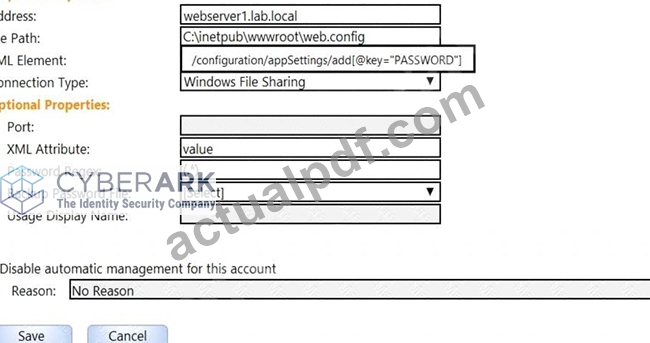
- A. Use the "change" button on the parent account's details page.
- B. Use the "change" button on the usage's details page.
- C. Use the "reconcile" button on the parent account's details page.
- D. Use the "sync" button on the usage's details page.
Answer: D
Explanation:
Explanation
A usage is a configuration that allows CyberArk to manage passwords for files, such as XML or INI files, that are stored on remote machines. A usage is associated with a parent account, which is the account that has access to the file. To update the password of a usage, the least intrusive way is to use the "sync" button on the usage's details page. This will synchronize the password value between the Vault and the file, without changing the actual password. The "change" button will initiate a password change process by the CPM, which will generate a new random password for the usage and the file. The "reconcile" button will initiate a password reconcile process by the CPM, which will use a reconcile account to reset the password of the usage and the file to the value stored in the Vault. References: Usages, Manage passwords for usages
NEW QUESTION # 130
......
CyberArk PAM-DEF (CyberArk Defender - PAM) Certification Exam is a globally recognized certification exam designed to validate the skills and knowledge of CyberArk PAM (Privileged Access Management) professionals. PAM-DEF exam is administered by CyberArk, a leading provider of cybersecurity solutions, and is intended to certify that candidates have the technical expertise and practical experience necessary to effectively deploy and manage CyberArk PAM solutions.
100% Free PAM-DEF Daily Practice Exam With 240 Questions: https://testinsides.actualpdf.com/PAM-DEF-real-questions.html
